Truth&Date

Truth&Date

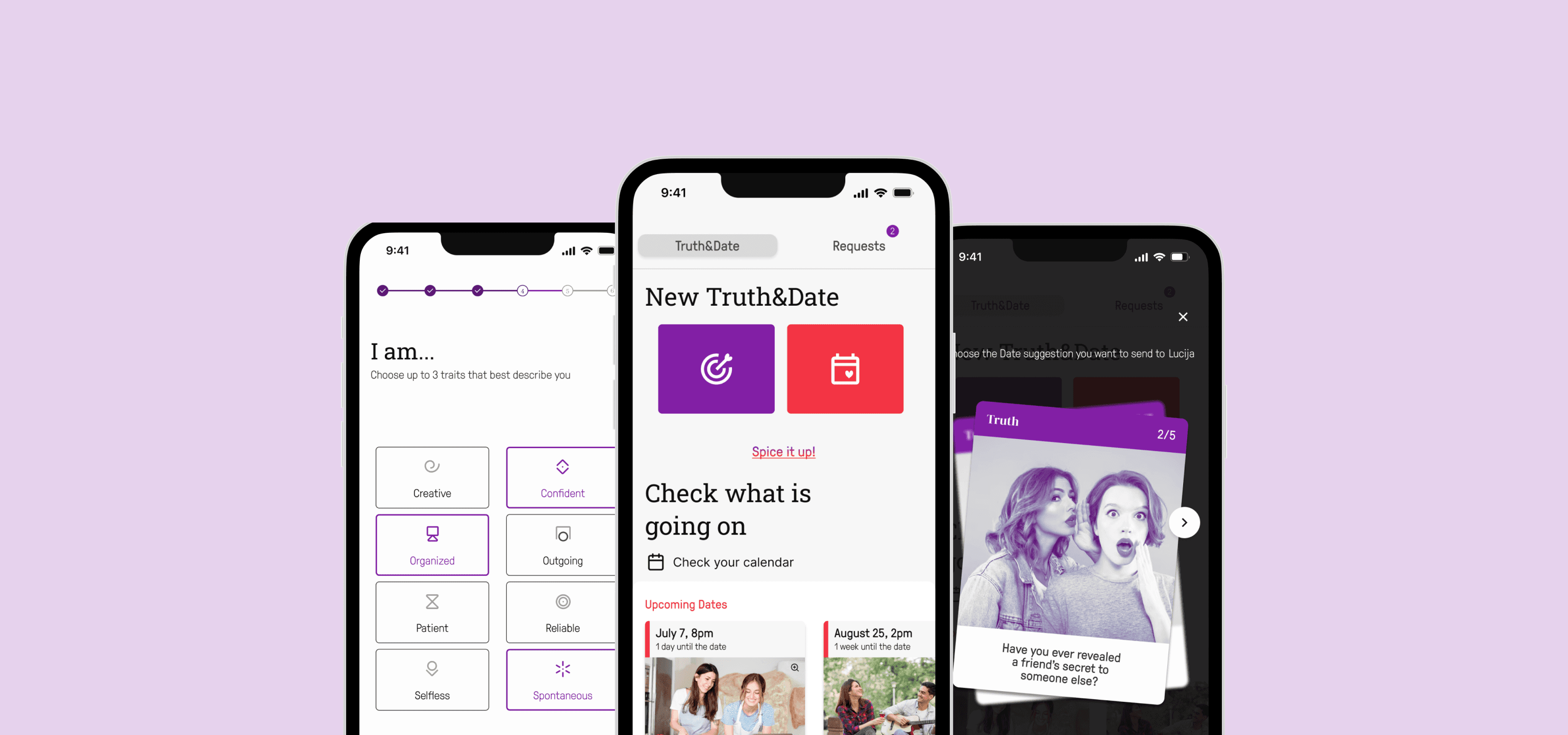
Dating app designed for people looking for meaningful connections and experiences.

OVERVIEW

The current dating app system is broken and not fit to facilitate fulfilling relationships. By improving the technology behind it, better and more meaningful connections can be fostered.

INFO

Role

Research

Ideation

Design System

High-fidelity wireframes and advanced prototyping

User Testing

Team

5 UX/UI Design students

Timeline

6 months

PROBLEMS TO SOLVE

Lack of engagement

Low quality matches

Ghosting

Choice overload

GENERATIVE RESEARCH

Methods

Desk Research, Surveys, User Interviews

Survey

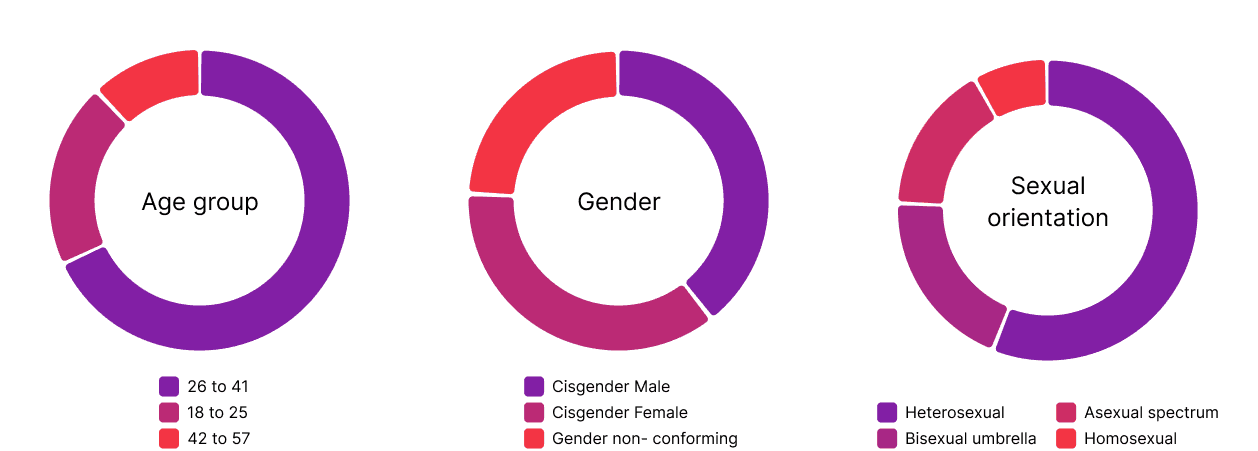
The purpose of this survey was to gather data about current trends and challenges when it comes to relationships and dating. The survey included demographic questions, questions about the challenges that modern relationships bring, and questions about types of relationships (monogamy, polyamory, etc.). The survey also included open-ended questions and reached a total of 101 respondents.

The purpose of this survey was to gather data about current trends and challenges when it comes to relationships and dating. The survey included demographic questions, questions about the challenges that modern relationships bring, and questions about types of relationships (monogamy, polyamory, etc.). The survey also included open-ended questions and reached a total of 101 respondents.

50.5%

Participants were in an exclusive monogamous relationship at the time of taking the survey

74%

survey takers want long-term monogamous relationships

Most common dating app challenges identified with the survey:

55%

Different levels of commitment

65%

Different values, beliefs and goals

44%

Boredom or routine

User Interviews

1 month

timeline

22 people

22 people

interviewed

RESEARCH OUTCOMES

Key Pain Points

The abundance of options

Deception and scams

Superficiality and profile projection

Communication barriers

Financial and time constraints

By analyzing these challenges, we can better understand the complex landscape of modern dating. As we progress in this case study, we will explore potential solutions and strategies to address these issues, ultimately aiming to create an inclusive and fulfilling dating environment that fosters genuine connections based on shared values, interests, and compatibility.

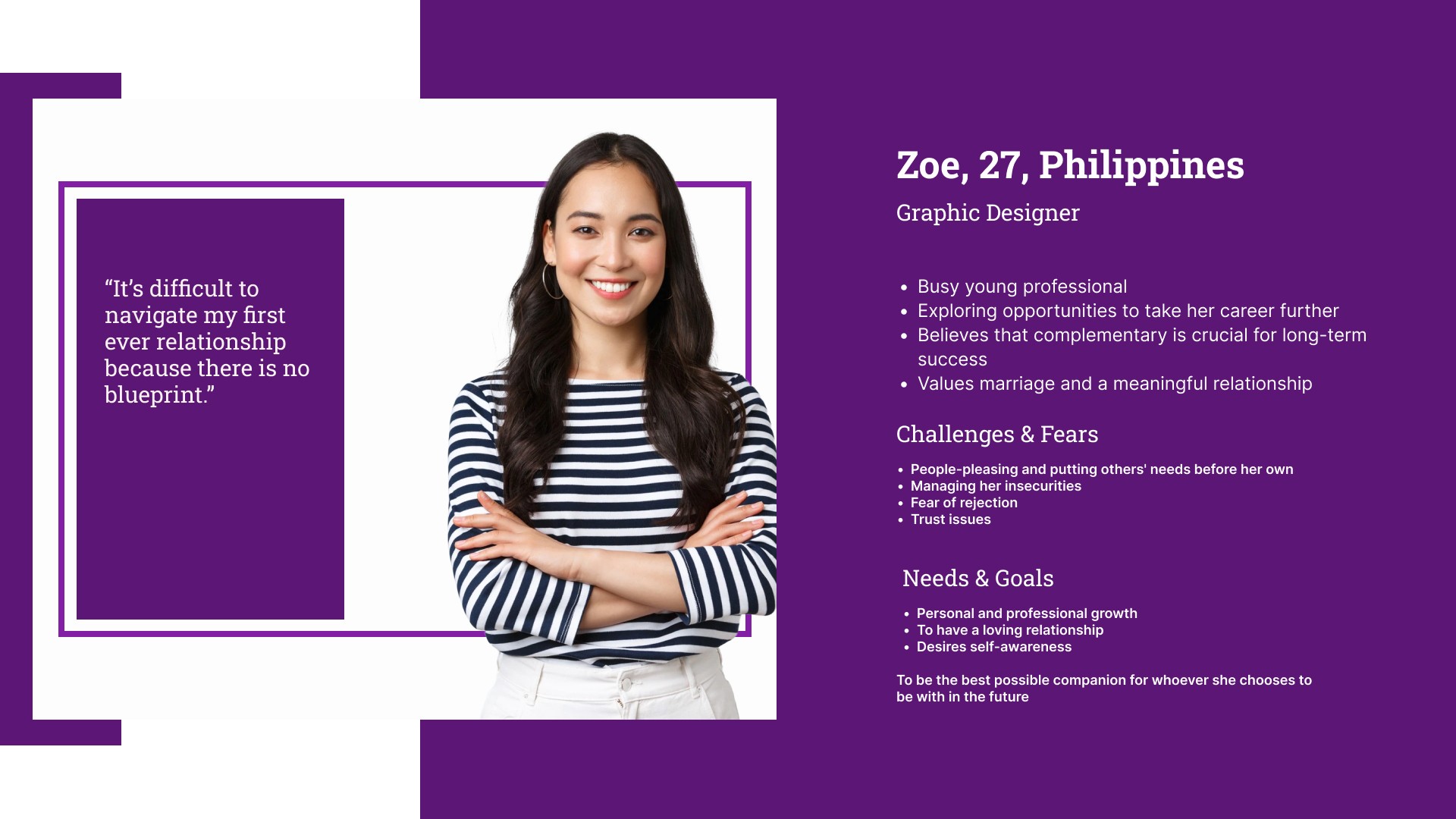
User Persona
Empathy Map
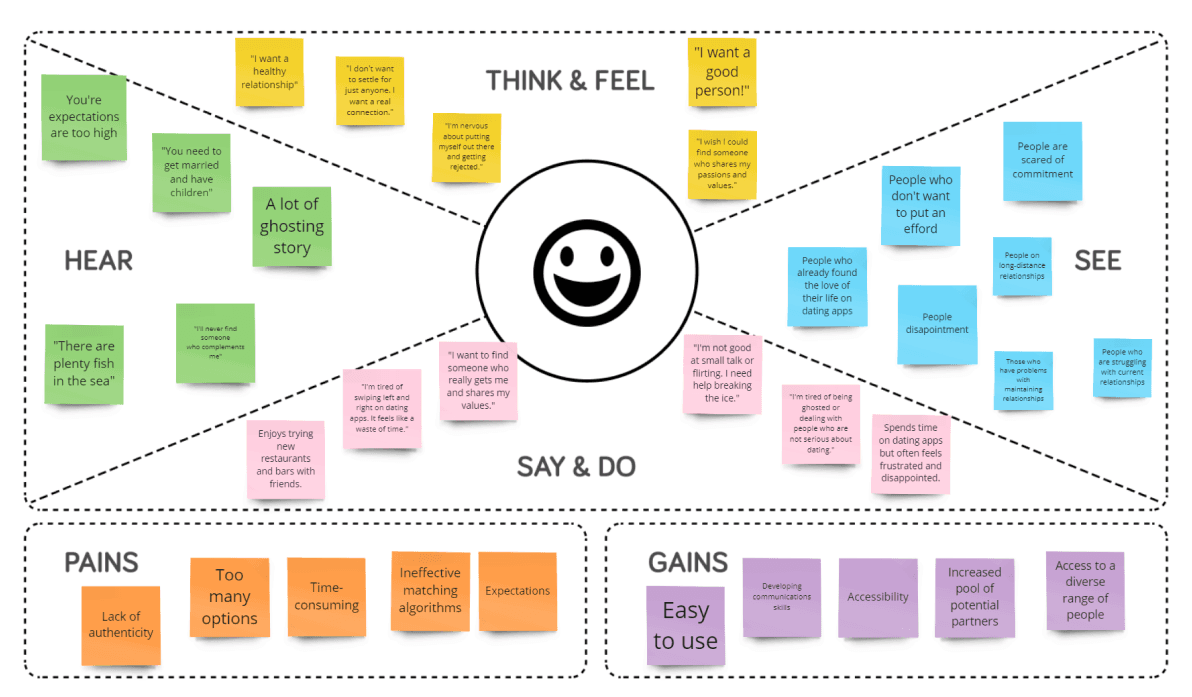
PROBLEM STATEMENT

How can dating apps adapt so they can facilitate more fulfilling relationships?

How can dating apps adapt so they can facilitate more fulfilling relationships?

There are many ways in which modern dating can improve, but we decided to address the following issues:

Lack of engagement

Low quality matches

Ghosting

Choice overload

UNIQUE FEATURES

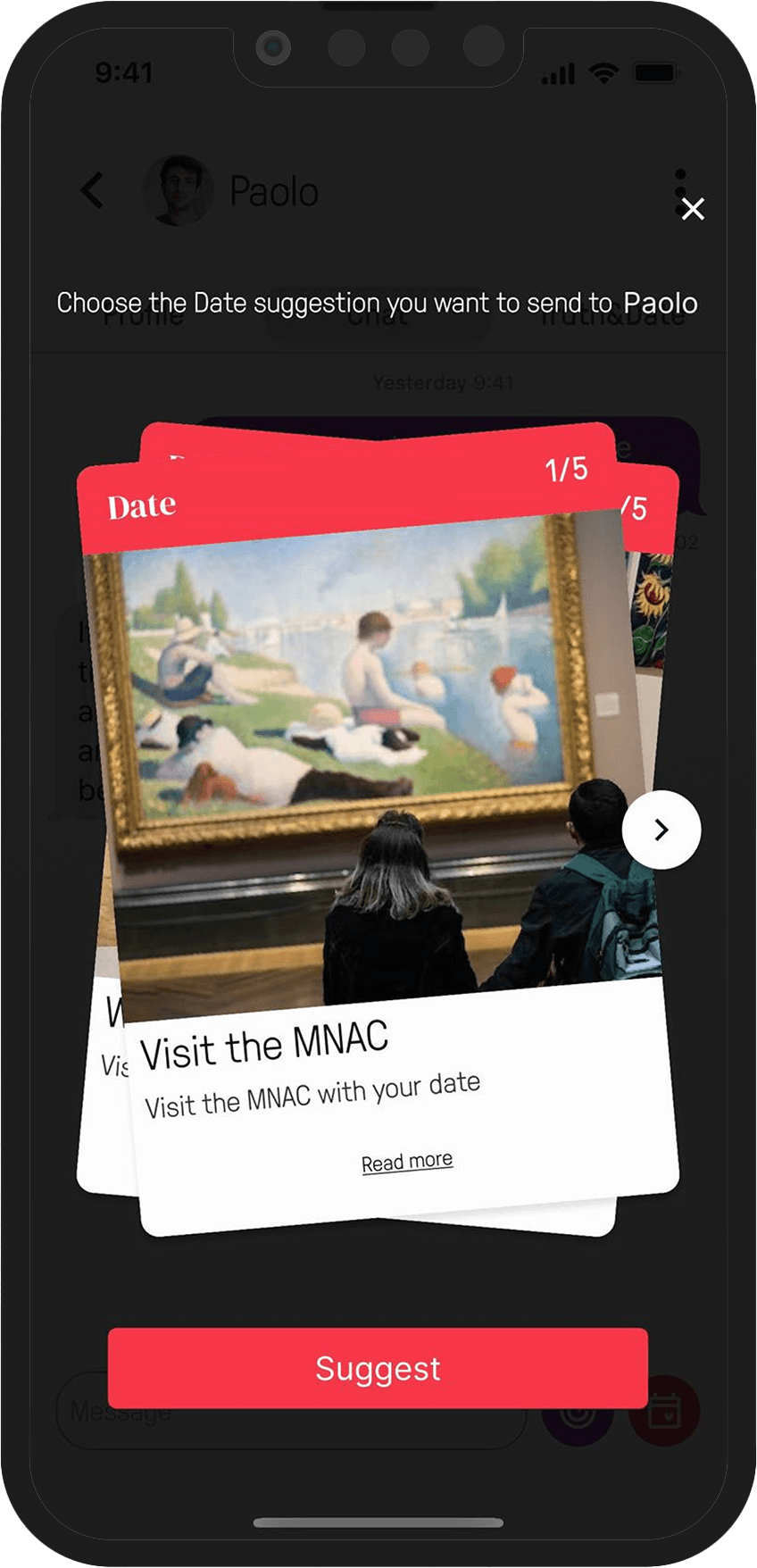
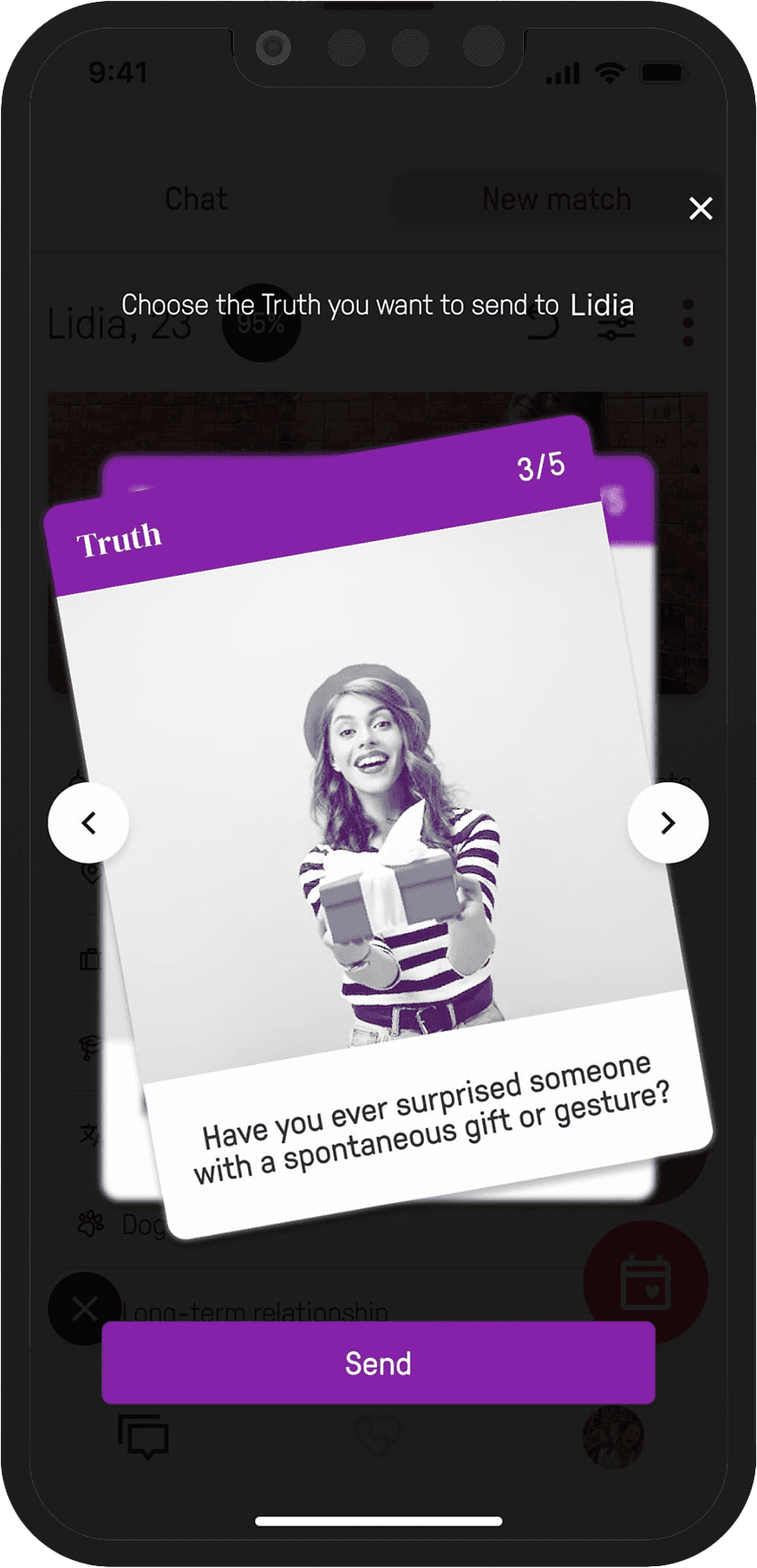
Gamified engagement increasing model based on Truth or Dare social game.

Users get AI generated suggestions for questions and date ideas to send their matches which increases engagement within the app.
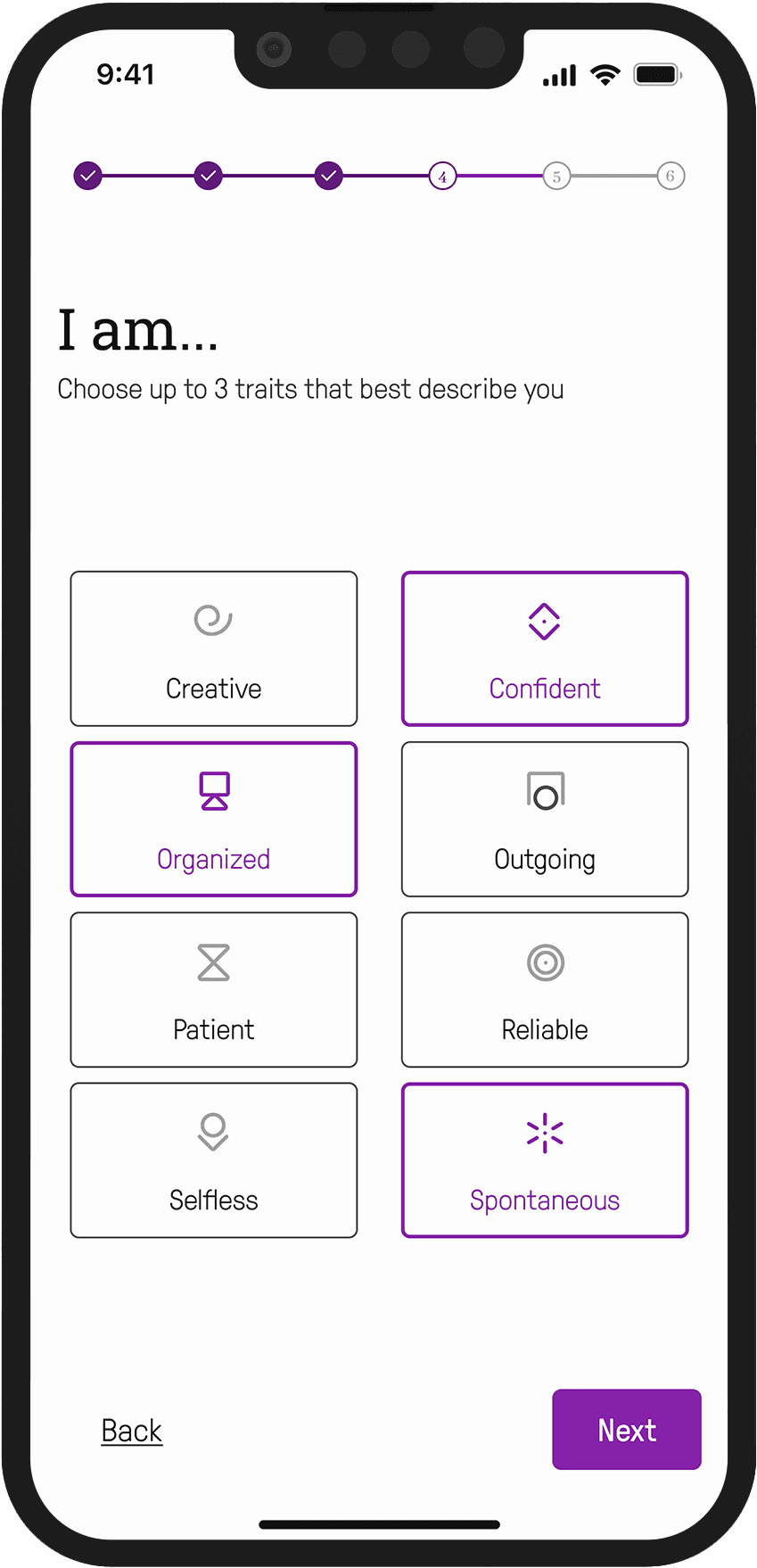
AI powered matching algorithm that matches users based on complementary matches

To improve the quality of the matches, match suggestions are based on complementary traits, and values that users input during the registration.
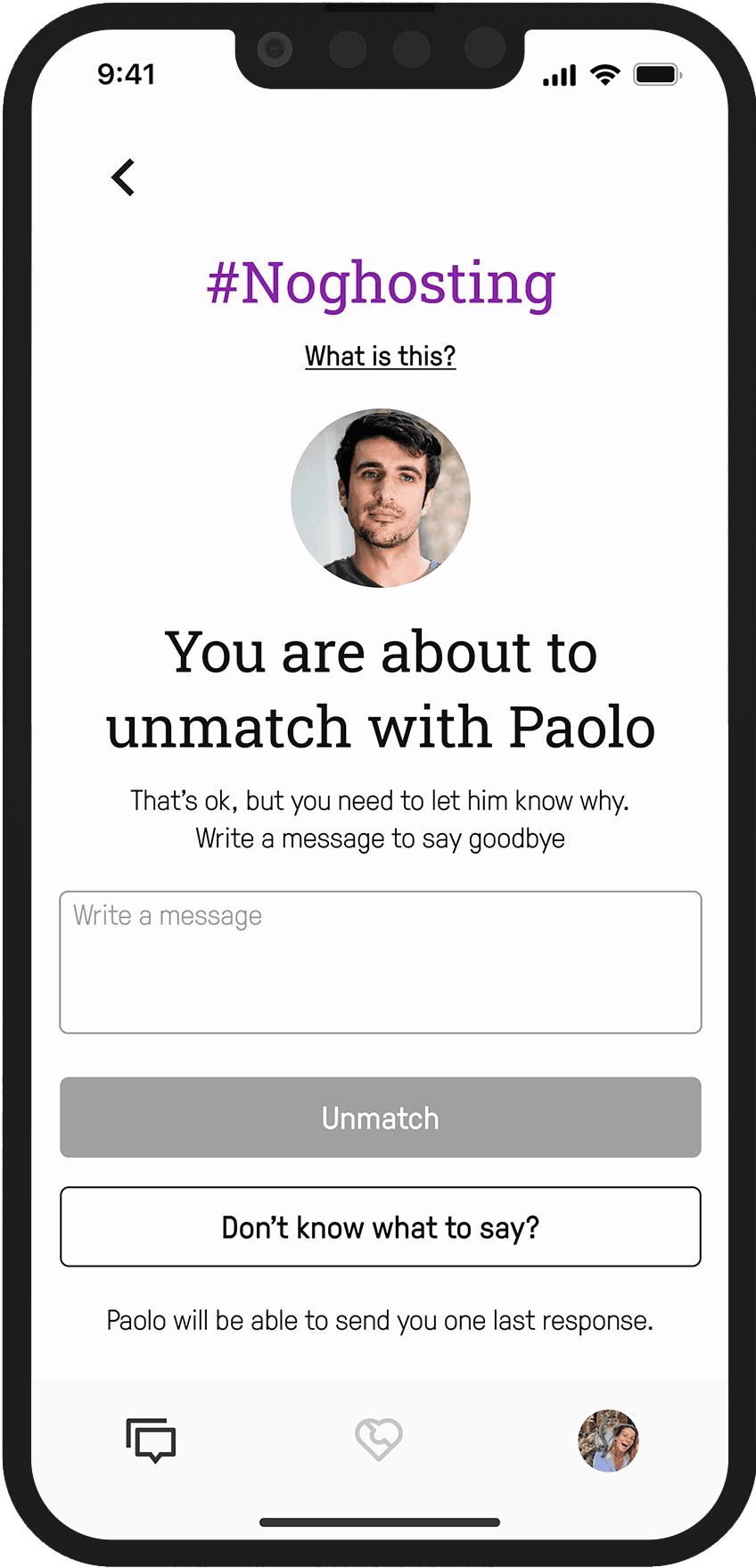
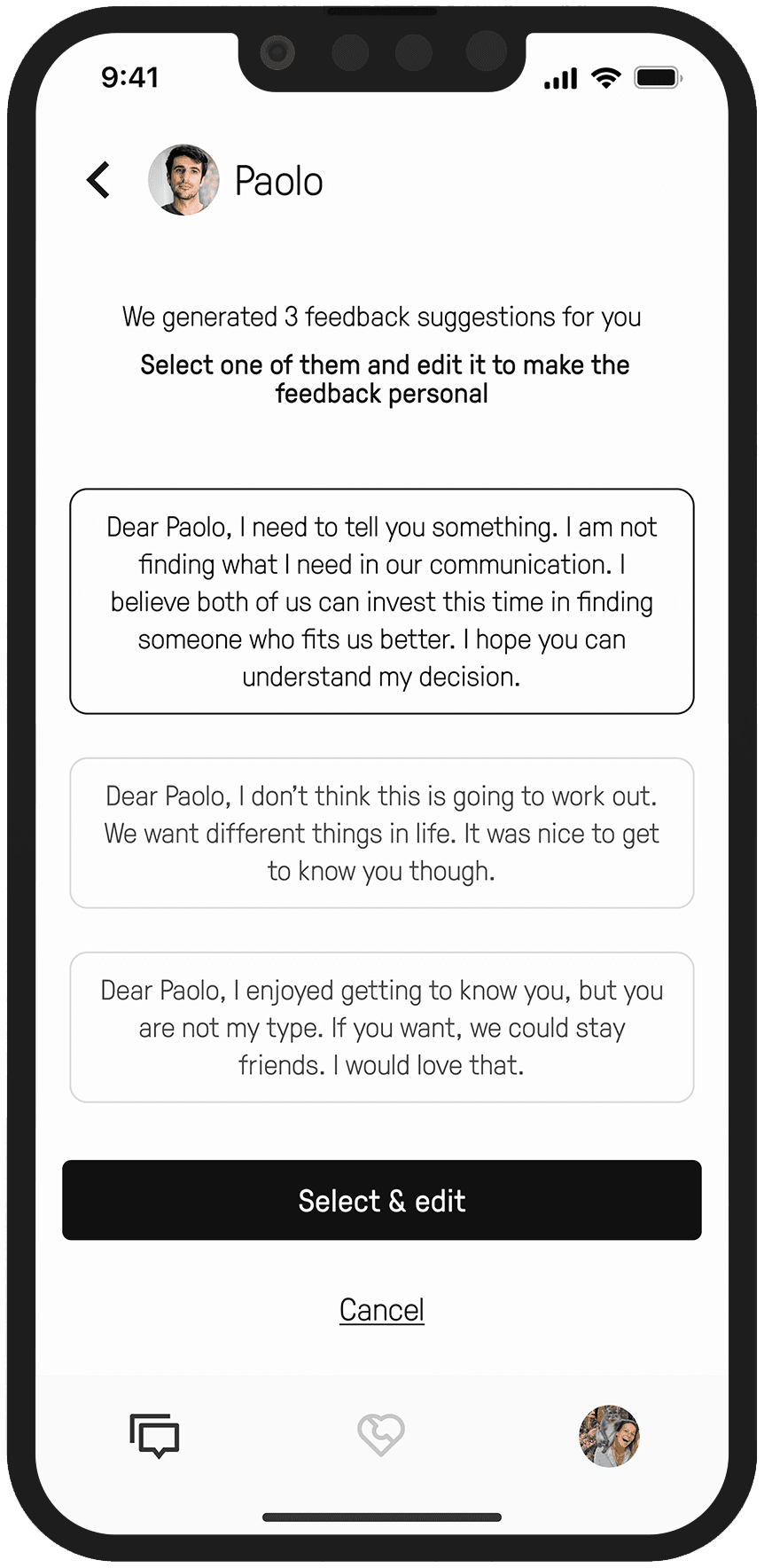
Paired with the limited matches, the #NoGhosting feature ensures respect and communication. Unmatching without providing the valid reason to the person and the app is impossible. And when you don’t know what to say, the AI in the app will suggest tailored templates that you can edit and send a personalized message to say goodbye.

A no-ghosting feature that requires that users send a goodbye message before unmatching

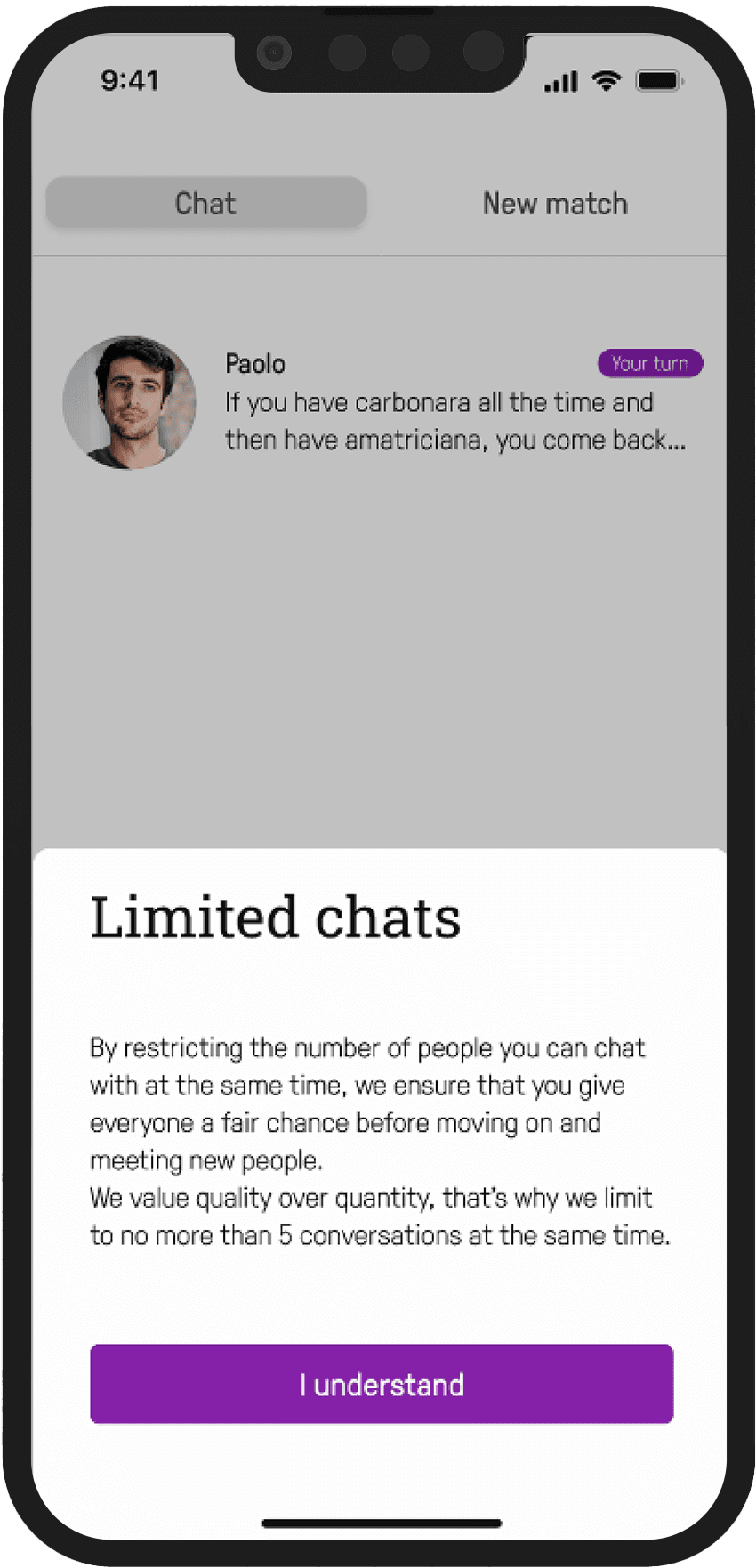
Limited matches feature that does not allow users to engage with more than 5 people at time

Users can only interact with 5 people at a time, ensuring that Choice overload is reduced and users can focus on getting to know each of the matches they have.
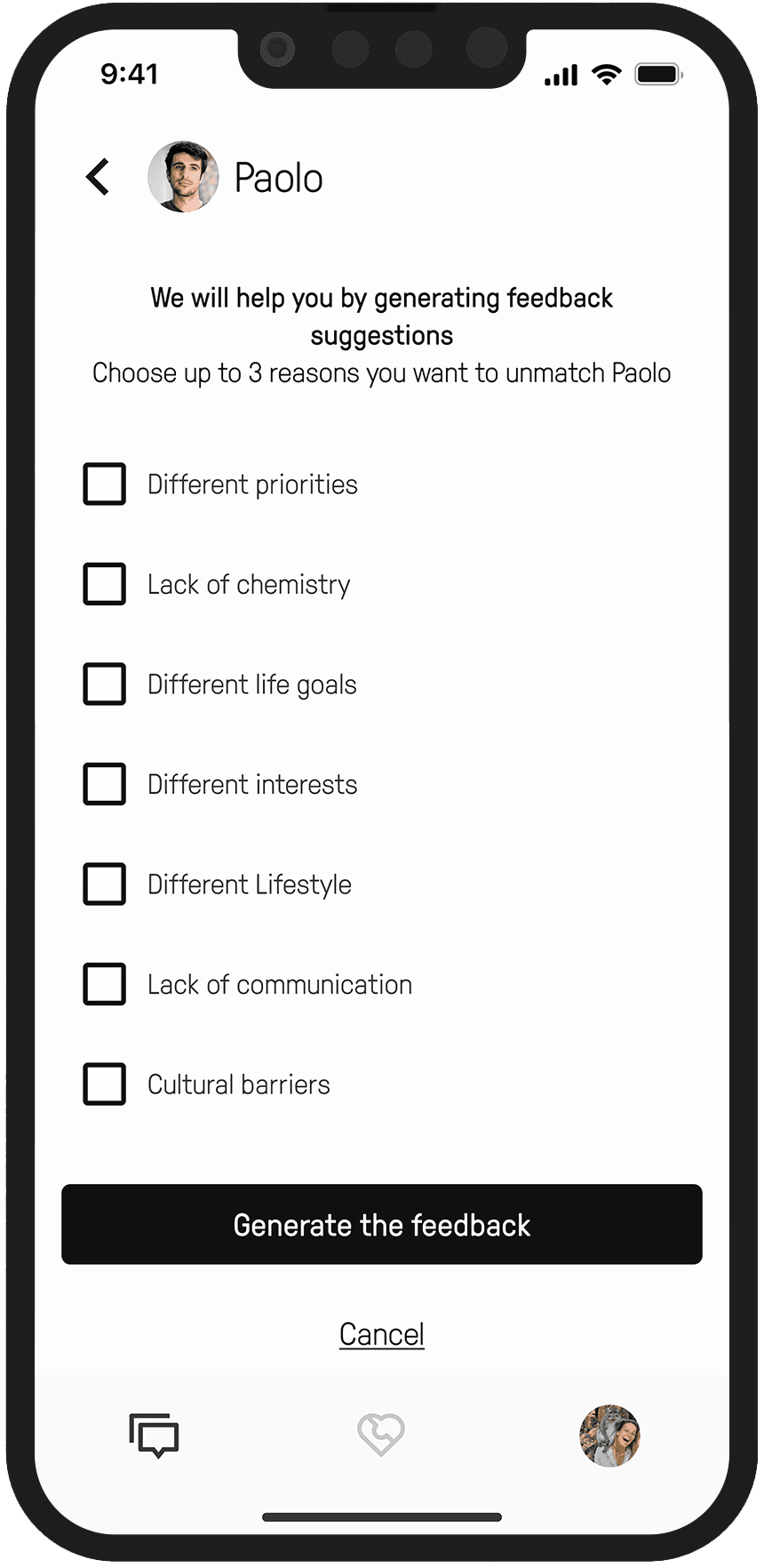
A no-ghosting feature that requires that users send a goodbye message before unmatching

Paired with the limited matches, the #NoGhosting feature ensures respect and communication. Unmatching without providing the valid reason to the person and the app is impossible. And when you don’t know what to say, the AI in the app will suggest tailored templates that you can edit and send a personalized message to say goodbye.

USER TESTING & ITERATION

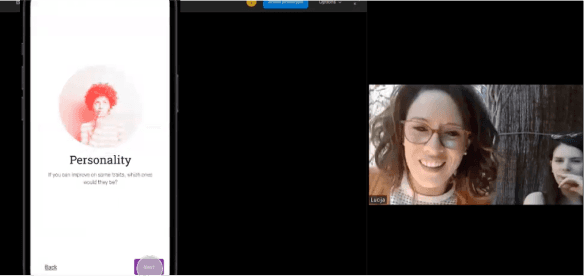
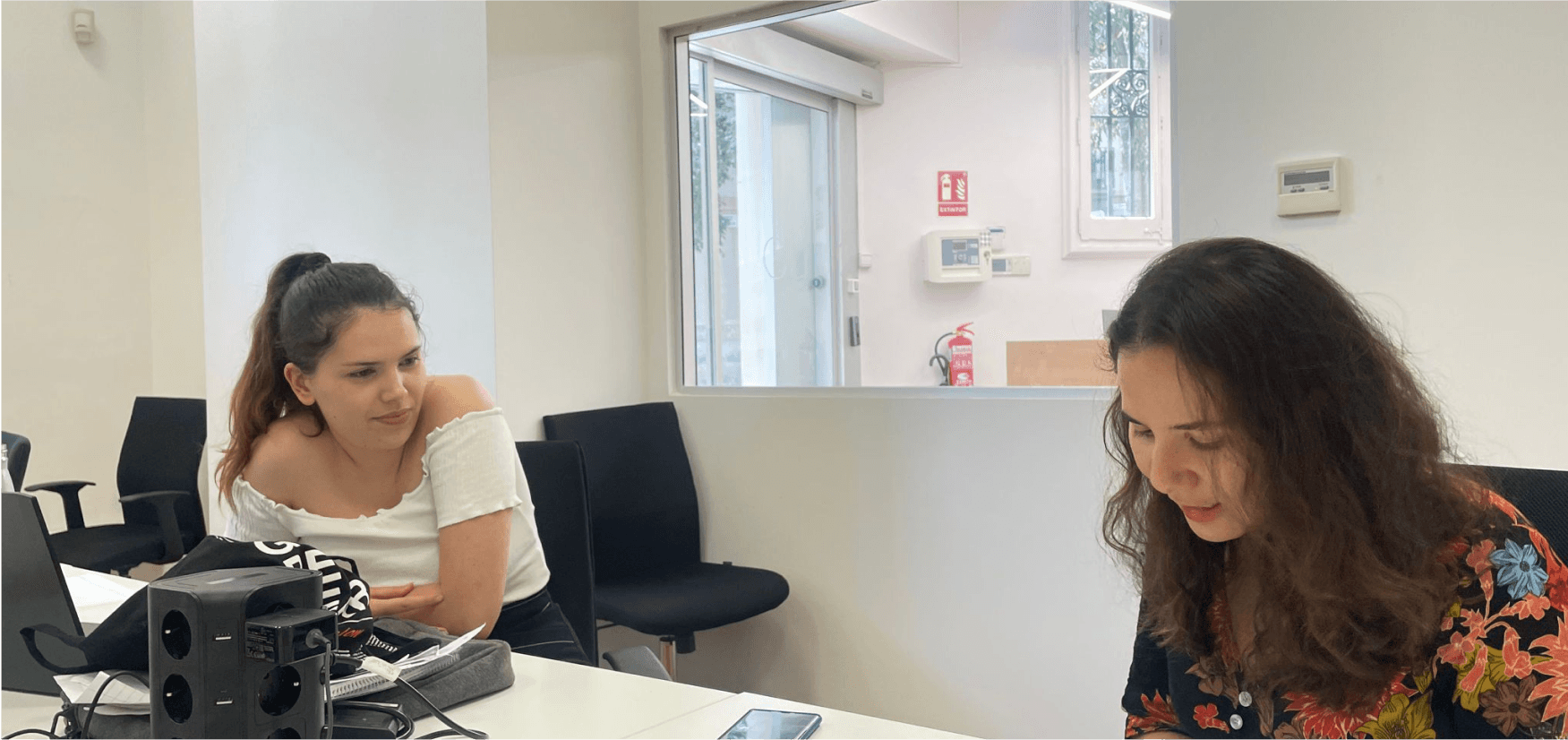
Different variations and fidelities of the prototype were tested with users throughout the project, each highlighting different issues and improvement opportunities. The testing was conducted either in person or remotely, depending on the participant’s needs.

Testing was conducted with 4-5 users for each stage (low, mid and high-fidelity iteration), all of whom fit the profile of the target audience (Persona).

USER TESTING AND ITERATION

User Testing

Different variations and fidelities of the prototype were tested with users throughout the project, each highlighting different issues and improvement opportunities. The testing was conducted either in person or remotely, depending on the participant’s needs.


Testing was conducted with 4-5 users for each stage (low, mid and high-fidelity iteration), all of whom fit the profile of the target audience (Persona).

Prototype Iterations

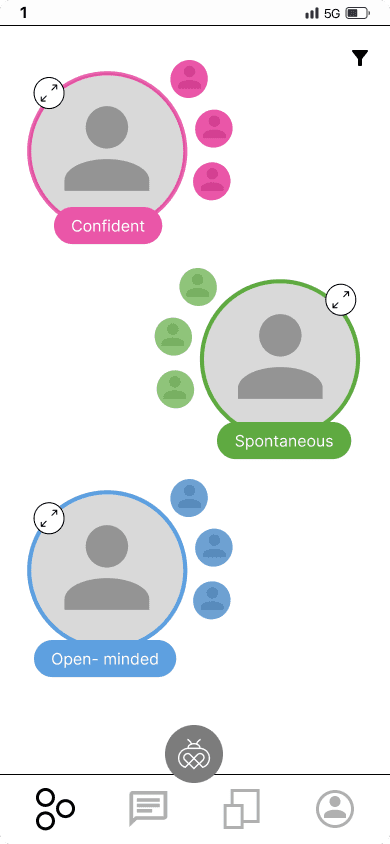
Throughout the process, all the design decisions were made based on the user feedback during testing sessions. It's interesting to notice that the more the designs were tested, the simpler they became. In the example of the matching screen, the first iteration was supposed to be inventive and highlight all the suggested matches based on the complementary traits they have. This approach proved not to be intuitive and was therefore scrapped.

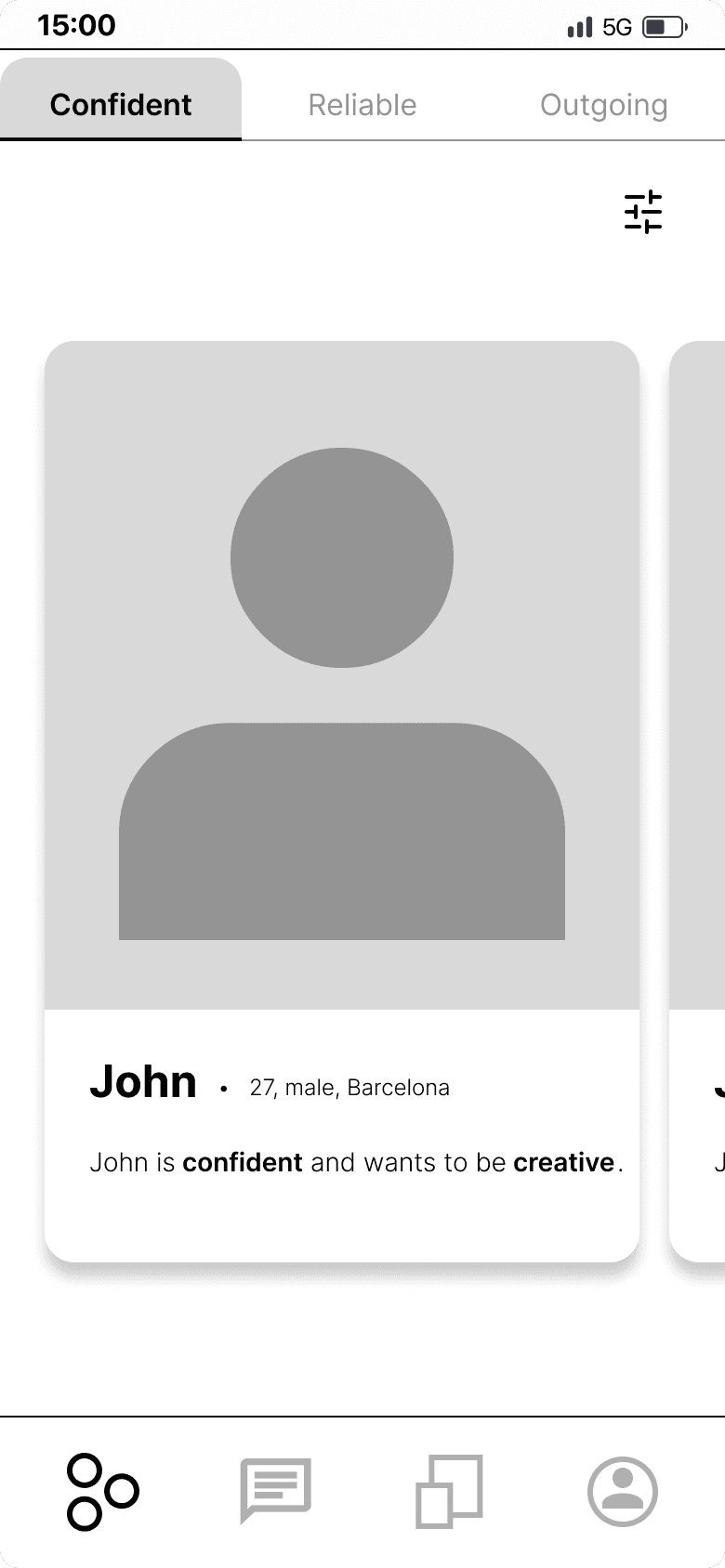
In the second iteration, the highlight was still on separating the users by traits, but this time, the user profile was more prominent. Using the horizontal scroll, the users were able to browse all options for each trait. In this version, users can see up to nine profiles daily.


During testing, users expressed disappointment with the limited amount of profile they can see. We also observed that users were scrolling instead of opening the profiles and seeing the full details.


While we have to take into consideration that user behaviour won't be the same once the placeholders are replaced with real images, we do want to encourage users to spend more time reviewing each profile.

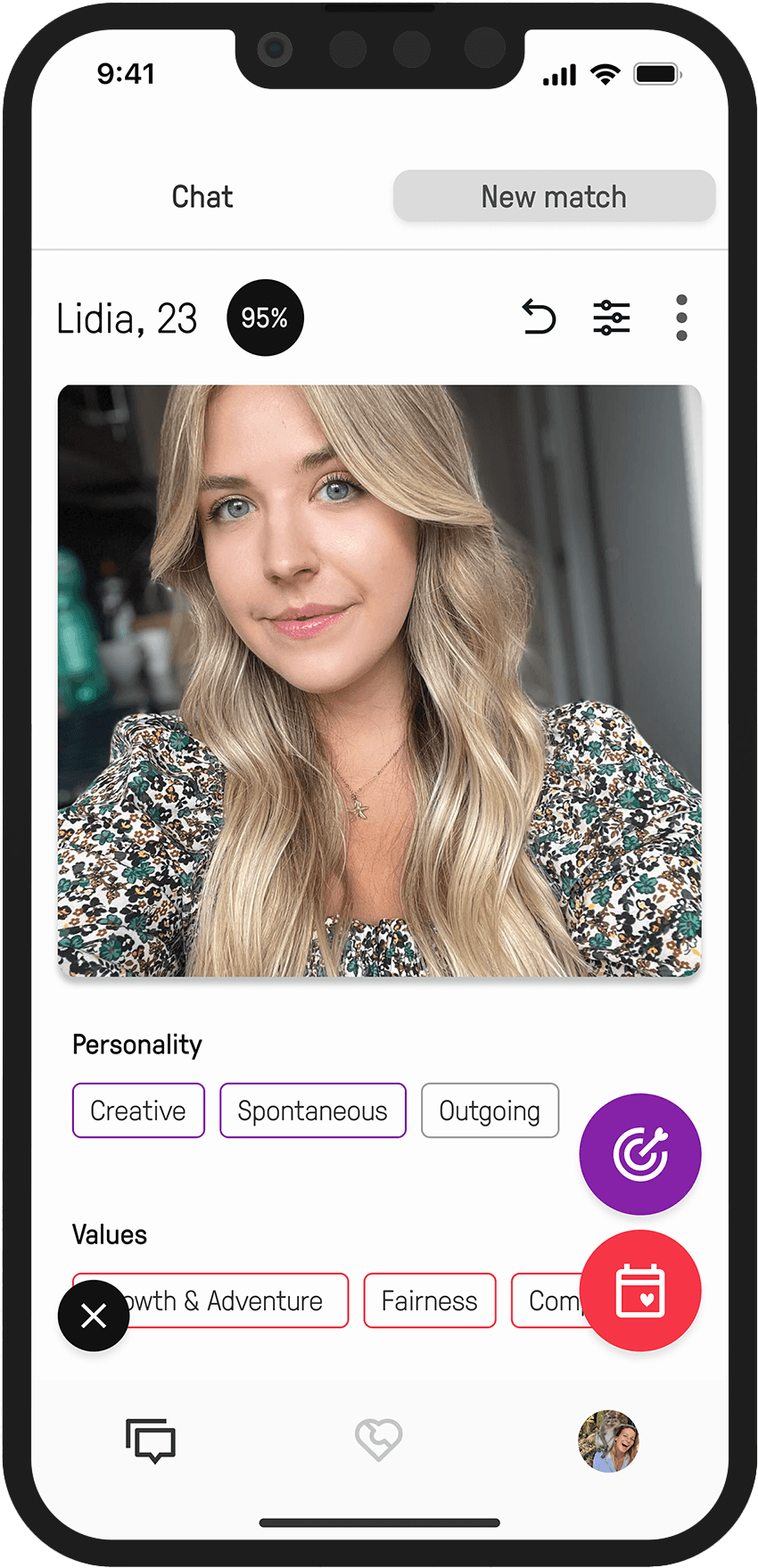
In the final version, we decided that having the profiles by the complementary traits was not necessary and can only lead to confusion. We focused on highlighting the complementary traits and common values for each profile, and we also included a match percentage. This information gives the user an quick overview of how compatible they are, motivating them to scroll further and discover more about their potential match.


The key matching features, Truth and Date were also highlighted as main actions and fixed so the user can always have easy access to the interactions when they make their decision.


The whole app went through a similar iteration process which allowed us to go from a very complex first version to a more intuitive and user-friendly final design.

FINAL PROTOTYPE

View prototype

LEARNINGS

Trusting the process is key to building a successful product, and it requires time, research, and iterative design. User testing and feedback collection at various stages are crucial for validating decisions and uncovering areas for improvement. Recognizing when to pivot based on test results is essential, fostering adaptability for design adjustments. This project has highlighted the complexity of human behavior in relationship design, emphasizing the need for empathy and a deep understanding of interactions. These experiences have not only improved my UX design skills but also broadened my perspective on design's role in facilitating connections and improving lives.

Trusting the process is key to building a successful product, and it requires time, research, and iterative design. User testing and feedback collection at various stages are crucial for validating decisions and uncovering areas for improvement. Recognizing when to pivot based on test results is essential, fostering adaptability for design adjustments. This project has highlighted the complexity of human behavior in relationship design, emphasizing the need for empathy and a deep understanding of interactions. These experiences have not only improved my UX design skills but also broadened my perspective on design's role in facilitating connections and improving lives.

Prototype Iterations

Throughout the process, all the design decisions were made based on the user feedback during testing sessions. It's interesting to notice that the more the designs were tested, the simpler they became. In the example of the matching screen. the first iteration was supposed to be inventive and highlight all the suggested matches based on the complementary traits they have. This approach proved not to be intuitive and was therefore scrapped.

In the second iteration, the highlight was still on separating the users by traits, but this time, the user profile was more prominent. Using the horizontal scroll, the users were able to browse all options for each trait. In this version, users can see up to nine profiles daily.


During testing, users expressed disappointment with the limited amount of profile they can see. We also observed that users were scrolling instead of opening the profiles and seeing the full details.


While we have to take into consideration that user behaviour won't be the same once the placeholders are replaced with real images, we do want to encourage users to spend more time reviewing each profile.

In the final version, we decided that having the profiles by the complementary traits was not necessary and can only lead to confusion. We focused on highlighting the complementary traits and common values for each profile, and we also included a match percentage. This information gives the user an quick overview of how compatible they are, motivating them to scroll further and discover more about their potential match.


The key matching features, Truth and Date were also highlighted as main actions and fixed so the user can always have easy access to the interactions when they make their decision.


The whole app went through a similar iteration process which allowed us to go from a very complex first version to a more intuitive and user-friendly final design.